Here’s the uncomfortable truth: some of your best hiring decisions might not be on paper, and some of your worst hires might’ve looked perfect on paper.
That’s because today, technical skills aren’t your biggest differentiator. Values are.
The most forward-thinking companies aren’t just hiring for what people can do.
They’re hiring for what people believe.
This issue is about shifting from “culture fit” to culture add, and why purpose-driven hiring isn’t fluff. It’s your next strategic edge. Let’s dig in.
Why Purpose-Driven Hiring Is Your Competitive Advantage
Hiring with purpose isn’t about being idealistic, it’s about being strategic.
When you hire people who align with your company’s values and purpose, you:
- Boost engagement
- Improve retention
- Attract stronger referrals
- Build trust with clients, stakeholders, and candidates
Simon Sinek popularized this with his now-iconic idea: “People don’t buy what you do, they buy why you do it.” The same goes for talent. Employees today want to work somewhere that reflects who they are. Not just what they can do.
A 2023 survey by Deloitte found that two-thirds of Millennial and Gen Z workers would leave a company whose values didn’t align with their own. This isn’t a fringe trend, it’s a generational shift in how people choose where (and why) they work.
Culture Add Pivot
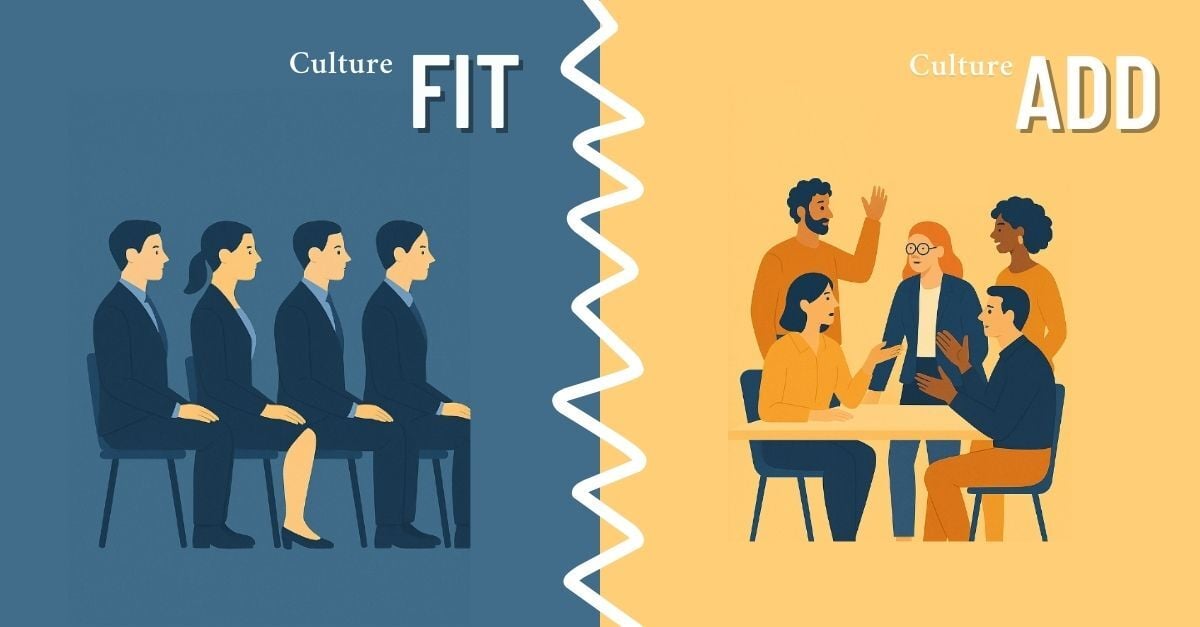
Several years ago, some companies like LinkedIn, made subtle but powerful shift in how it hires: it moved away from hiring for “culture fit” and toward hiring for “culture add.”
The problem with “fit”? It often meant hiring people who looked like, sounded like, and thought like everyone else. That led to groupthink, unconscious bias, and a lack of fresh perspective.
“Culture add” flips the script. It says:
We want people who believe what we believe, but who bring something new to the table.
This is where Cultural Intelligence (CQ) comes in: the ability to hire, and lead, across differences. And it’s one of the most important leadership traits in fast-growing, modern companies.
The “Like-Me” Trap
When founders or hiring managers rely on gut feel or say “I just like this person,” they’re often falling into what psychologists call the “like-me” bias.
It feels safe, but it stifles innovation and leads to sameness.
Instead, smart hiring leaders anchor decisions in shared values and diverse perspectives. They ask:
- Does this person believe in our mission?
- Will they challenge us in ways we need?
- Are they bringing a different lens we’re missing?
Tactical Tool: Scorecards for Values Alignment
Purpose-driven hiring requires structure. That’s where scorecards come in.
A good hiring scorecard doesn’t just track role-specific skills, it explicitly ties candidate evaluation to your core company values.
Take Mars, Inc., for example. The global company built around beloved brands like M&Ms and Pedigree bases every decision (hiring included) on five key values: Quality, Responsibility, Mutuality, Efficiency, and Freedom.
Their values are:
- Displayed in every office
- Referenced in meetings
- Embedded into performance reviews and hiring scorecards
That means when evaluating a candidate, you’re not just asking:
“Can this person do the job?”
They’re also asking:
“Will this person live the values that drive our culture?”
Tip for Founders & HR Teams:
If your scorecard doesn’t reflect your values, you’re hiring blind.
Make sure your team can define each value in behavioral terms, then ask interview questions that reveal alignment.
Sample Scorecard Values (and What to Look For)
- Curiosity: Asks questions, learns fast, welcomes feedback.
Interview prompt: “Tell me about a time you learned something outside your role—and used it.”
- Ownership: Takes initiative, follows through.
Interview prompt: “When did you take responsibility for a problem not technically yours?”
- Integrity: Does what’s right even when it’s hard.
Interview prompt: “Describe a time doing the right thing cost you something.”
- Collaboration: Builds bridges, not silos.
Interview prompt: “Give an example of influencing without authority.”
Our Perspective
You can teach someone how to use a CRM or follow a process.
But you can’t teach them what to believe.
Purpose-driven hiring attracts people who will go the extra mile, not because they have to, but because they care. It builds teams that challenge each other, evolve your culture, and drive long-term growth.
And that’s your real competitive advantage.
Need help getting the right people in the right seats, or help building values-aligned scorecards and hiring playbooks? Let’s talk.